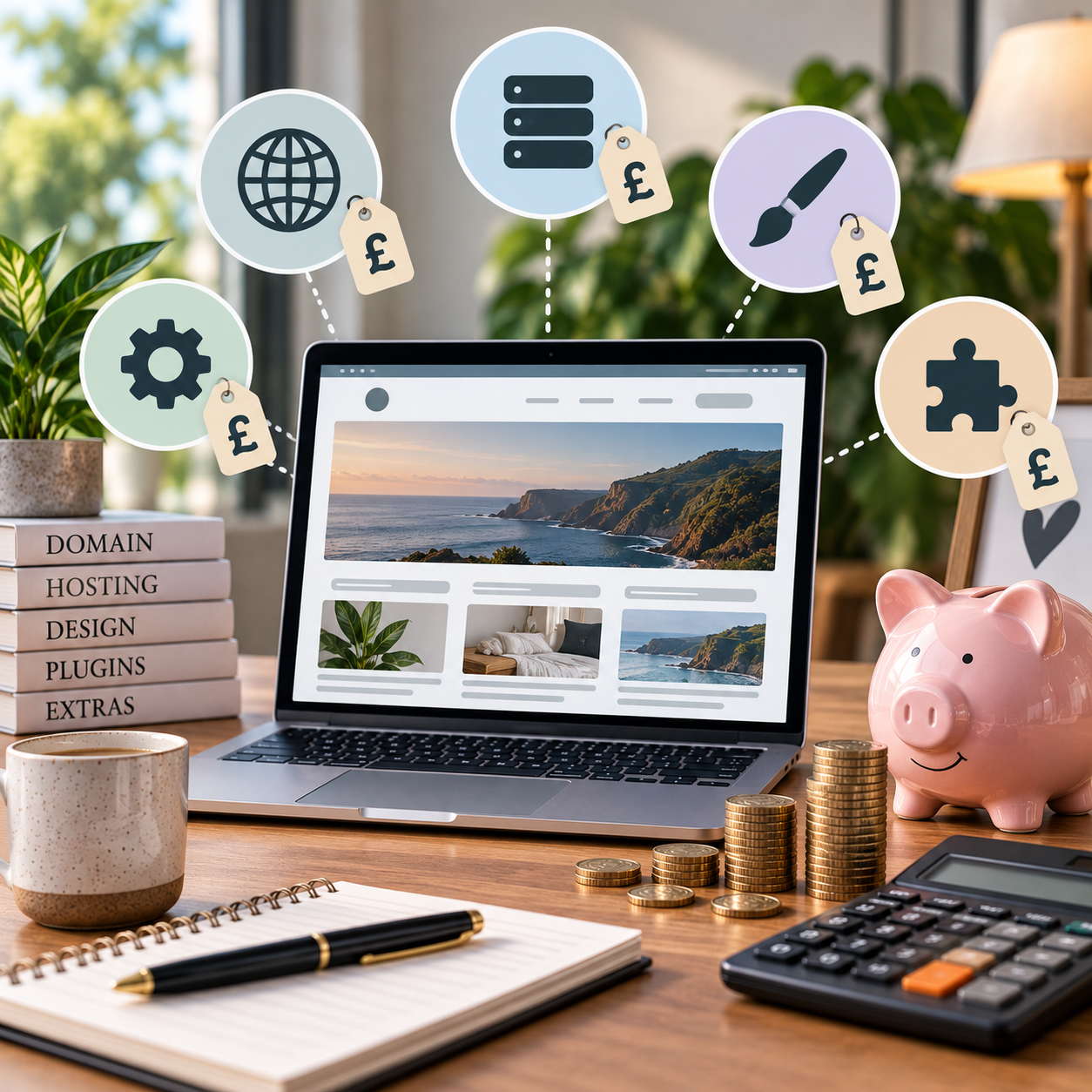
If you’re wondering how much does a website cost UK, the answer can range from less than £100 a year for a simple website you build yourself to hundreds or thousands of pounds if you pay someone to design and build it for you.
That enormous difference is one reason website pricing can seem so confusing.
People often compare two completely different costs: the cost of owning and running a website and the cost of paying someone for their time and expertise to build it.
If you’re prepared to build your own website, the actual technology doesn’t have to be particularly expensive. Your main costs may simply be a domain name and web hosting.
If you’d rather have someone do everything for you, you’re also paying for their time, design skills, technical knowledge and potentially copywriting, SEO, photography and ongoing support.
Let’s break down what a website really costs in the UK.
How much does a website cost in the UK?
As a rough guide, there are three main routes:
| Type of website | Typical cost |
|---|---|
| Free website builder | £0, but with significant limitations |
| DIY WordPress website | Potentially under £100 a year initially for a basic site |
| Professionally built website | Hundreds to several thousand pounds or more |
These aren’t fixed prices.
A five-page informational website for a local business is very different from an online shop containing hundreds of products.
But before paying anyone thousands of pounds for a website, it’s useful to understand what you’re actually paying for.
Option 1: Build your own WordPress website
For many beginners, this is one of the most affordable ways to create a proper website.
WordPress itself is free.
You normally need to pay for two things to get started:
A domain name — your website’s address, such as example.co.uk.
Web hosting — the service that stores your website and makes it accessible online.
Some hosting companies include a domain free for the first year when you purchase a hosting package.
At the time of writing, some introductory WordPress hosting deals start at only a few pounds per month when you pay for a longer period upfront.
That means it’s entirely possible to get a basic WordPress website online for less than £100 a year initially.
However, there’s an important catch.
Watch the renewal price
One of the easiest mistakes for a beginner to make is looking only at the introductory hosting price.
A hosting company might advertise something like £2.99 per month, but that price may require paying several years upfront and may increase significantly when the initial term ends.
Always check:
- how much you’re paying today;
- how long that price lasts;
- whether you have to pay upfront;
- whether the domain is included;
- what the domain costs after the first year; and
- what the hosting renews at.
The cheapest advertised monthly figure isn’t necessarily the long-term cost of the website.
Do I have to pay for WordPress?
No.
The WordPress software itself is free and open source.
You can also find thousands of free themes and plugins.
That’s important because beginners are sometimes given the impression that they need to buy a premium theme, page builder and collection of plugins before they can create a decent website.
You don’t.
We’re building this website using WordPress, and one of the things we’re testing is how much can be achieved without unnecessarily paying for tools simply because they’re marketed as essential.
You can always upgrade something later when you have a genuine reason to.
What optional costs might a WordPress website have?
Although WordPress itself is free, you can choose to spend money on additional tools.
These might include:
- premium themes;
- premium plugins;
- page builders;
- business email;
- backup services;
- security tools;
- SEO software;
- booking systems;
- ecommerce extensions; or
- specialist functionality.
The important word here is optional.
Don’t build a shopping list of premium software before you’ve even created your website.
Start with what the website actually needs.
Option 2: Use a website builder
Website builders such as Wix and Squarespace take a different approach.
Instead of arranging hosting separately and installing WordPress, the platform provides the website-building system and hosting together.
This can make getting started easier.
You’re usually paying an ongoing subscription in return for that convenience.
Some website builders also offer free plans.
Can I build a website for free?
Technically, yes.
There are services that allow you to create and publish a website without paying anything.
But there’s usually a trade-off.
A free plan might mean:
- you can’t connect your own domain;
- the provider’s branding or adverts appear on your site;
- you receive limited storage or features;
- ecommerce isn’t available;
- some marketing features are restricted; or
- you need to upgrade to access functionality you eventually want.
That’s why I wouldn’t necessarily make £0 the goal when creating a serious website.
There’s a big difference between:
“Can I put a web page online for free?”
and:
“Can I build a website that I genuinely want to use for my business or project for free?”
For a real project, paying for your own domain and suitable hosting can be worth it.
Option 3: Pay someone to build your website
This is where website costs can increase dramatically.
You’re no longer paying only for the technology.
You’re paying someone to do the work for you.
Professional website prices in the UK vary enormously. A straightforward small-business website might cost hundreds or a few thousand pounds, while bespoke agency projects can cost considerably more.
Published UK pricing guides commonly place professional small-business websites somewhere from the hundreds into several thousand pounds, depending on what’s included.
That range is huge because “build me a website” isn’t a standard product.
What is a fair price to pay for a website?
A fair price depends on what you’re actually receiving.
Imagine two people both advertise a five-page website.
The first person installs a pre-designed template, changes the colours, adds your text and publishes it.
The second researches your business, plans the site structure, creates a custom design, writes or edits the copy, sources images, sets up analytics and Search Console, handles basic SEO, optimises the mobile experience and provides support after launch.
They’re both technically selling a five-page website.
They aren’t selling the same service.
Instead of asking only:
“How much does the website cost?”
ask:
“What exactly is included for that price?”
How much does a 10-page website cost?
There’s no standard price for a 10-page website.
The number of pages affects the workload, but page count alone doesn’t determine website cost.
Ten simple informational pages using the same design might be relatively straightforward to build.
Ten individually designed pages requiring original copywriting, custom graphics, photography, booking functionality and integrations are a completely different project.
If you’re getting quotes for a 10-page website, find out whether the price includes:
- design;
- building the pages;
- copywriting;
- images;
- mobile optimisation;
- contact forms;
- basic SEO setup;
- analytics;
- Search Console;
- legal pages;
- revisions;
- domain and hosting setup;
- training; and
- ongoing support.
Two quotes can look dramatically different until you compare what’s actually included.
Why do some websites cost thousands of pounds?
Part of the price is expertise.
A good web designer isn’t simply being paid to click buttons in WordPress.
They may be making decisions about:
- website structure;
- user experience;
- visual design;
- mobile responsiveness;
- accessibility;
- conversions;
- performance;
- search visibility;
- technical setup; and
- how the website supports the business behind it.
Then there are specialist requirements.
An online shop, membership website, booking platform or website with custom functionality can take considerably more work than a simple brochure website.
So an expensive quote isn’t automatically unreasonable.
Equally, an expensive quote isn’t automatically good.
You still need to understand what you’re getting.
Is it cheaper to build a website yourself?
In monetary terms, almost certainly.
If you build the website yourself, you’re removing one of the biggest costs: someone else’s time.
But you’re replacing it with your own.
You’ll need to learn how things work, make decisions, solve problems and actually build the pages.
For some people, that’s a good trade.
You might also gain a valuable skill and understand your website well enough to make changes without paying someone every time you want to update a paragraph.
For someone running a busy business, however, spending dozens of hours learning WordPress may cost more in lost time than paying somebody who already knows how to do it.
Neither option is automatically better.
DIY or professional web design?
A DIY website may make sense if:
- your budget is limited;
- your website is relatively simple;
- you’re willing to learn;
- you enjoy working things out;
- you want complete control; or
- you’re testing an idea before investing heavily.
Paying someone may make more sense if:
- you don’t have time to build it;
- technology frustrates you;
- the website is important to an established business;
- you need specialist functionality;
- you want professional design or copywriting; or
- you’d simply rather spend your time doing something else.
There’s also a middle ground.
You can build some of the website yourself and pay for help with specific parts.
What are the ongoing costs of a website?
The initial build isn’t necessarily the end of the expense.
Depending on how you’ve created the site, ongoing costs can include:
Domain renewal
Your domain normally needs renewing periodically.
A domain that’s included free for the first year may have a separate renewal charge afterwards.
Hosting renewal
Hosting is normally an ongoing expense.
Again, check the standard renewal rate rather than assuming your introductory deal lasts forever.
Website builder subscription
If you’re using a hosted website builder, you’ll generally need to keep paying for the plan while you use the service.
Premium software
Some WordPress themes and plugins charge annually rather than once.
Business email
A professional email address using your domain may have an additional cost depending on your provider.
Maintenance
If you pay somebody to maintain your website, this may be a monthly or annual expense.
Ecommerce costs
Online shops may also have payment-processing fees, ecommerce subscriptions or costs associated with particular features.
Marketing
Advertising, email marketing, SEO tools and other marketing services aren’t technically required to keep the website online, but they can become part of the wider cost of running it.
What website costs can I avoid as a beginner?
Quite a few.
You probably don’t need to immediately pay for:
- an expensive premium theme;
- several SEO tools;
- multiple premium plugins;
- a custom logo package;
- advanced analytics software;
- expensive stock-image subscriptions; or
- a maintenance package for a website you’ve only just started building.
This doesn’t mean those things never have value.
It means you should buy them because you’ve identified a problem they solve, rather than because a tutorial told you every website owner needs them.
What should I spend money on first?
For a straightforward first website, I’d prioritise:
1. A good domain name
Choose something you can realistically keep using.
2. Reliable hosting or an appropriate website-builder plan
You need somewhere suitable for the website to live.
3. Anything genuinely essential to the purpose of your site
For example, an ecommerce website may have requirements that a personal blog doesn’t.
Everything else can be evaluated as you build.
You don’t need to create the perfect technology stack before publishing your first page.
How much should a small business website cost?
This depends on whether you’re asking about running the website or having it professionally created.
A small business owner prepared to build a WordPress website themselves may be able to keep the initial technology costs very low.
A business hiring a professional is paying for a service as well as the underlying website technology.
That’s why two small-business owners can end up spending dramatically different amounts despite both having perfectly functional websites.
The right budget depends on what the website needs to achieve and how much work you want to do yourself.
Don’t forget the cost of changing your mind
There’s another cost that’s difficult to put into a pricing table.
Building the wrong website.
It’s easy to spend money on themes, plugins, design work and software before deciding:
- who the website is for;
- what it’s supposed to achieve;
- what pages it needs; and
- what visitors should be able to do.
Planning first can save money later.
That’s why we’ve put Plan before Build in this website’s learning path.
You don’t need months of planning.
You just need enough clarity to avoid paying for things you don’t need.
Want to build the website yourself?
That’s exactly what this site is here to help you do.
You don’t need to become a developer.
We’ll walk through choosing what you need, setting up WordPress, creating the essential pages, getting the website into Google and improving it using real search data.
If you’re at the very beginning, start with What Do I Need for a Website?
What if I want someone to build it for me?
You may reach the opposite conclusion.
Perhaps you understand that you could build the website yourself, but you don’t actually want to.
That’s completely reasonable.
We’re also exploring a straightforward done-for-you website design service for people who want the same beginner-friendly, no-unnecessary-jargon approach but would rather have the website built for them.
The important thing is that you understand what you’re paying for before deciding.
So, how much does a website cost UK?
For someone building a simple website themselves, the initial cost can potentially be less than £100 a year, particularly when using introductory hosting offers.
A free website is possible too, although free plans usually come with limitations.
If you’re paying someone to build your website, expect the price to move into the hundreds or thousands of pounds, depending on the amount of work, expertise and functionality involved.
The biggest mistake is assuming that every website price represents the same thing.
Before spending money, decide:
What does my website need to do?
What can I realistically do myself?
What am I happy to pay someone else to do?
Once you know those answers, website pricing becomes much easier to understand.
Leave a Reply